Blog Archives
Latest HIV blood results (August 2013)
Last week I popped into the HIV clinic to have my bloods taken, nine vials of the damned stuff – bleeding vampyrs! Today I popped back to get my results.
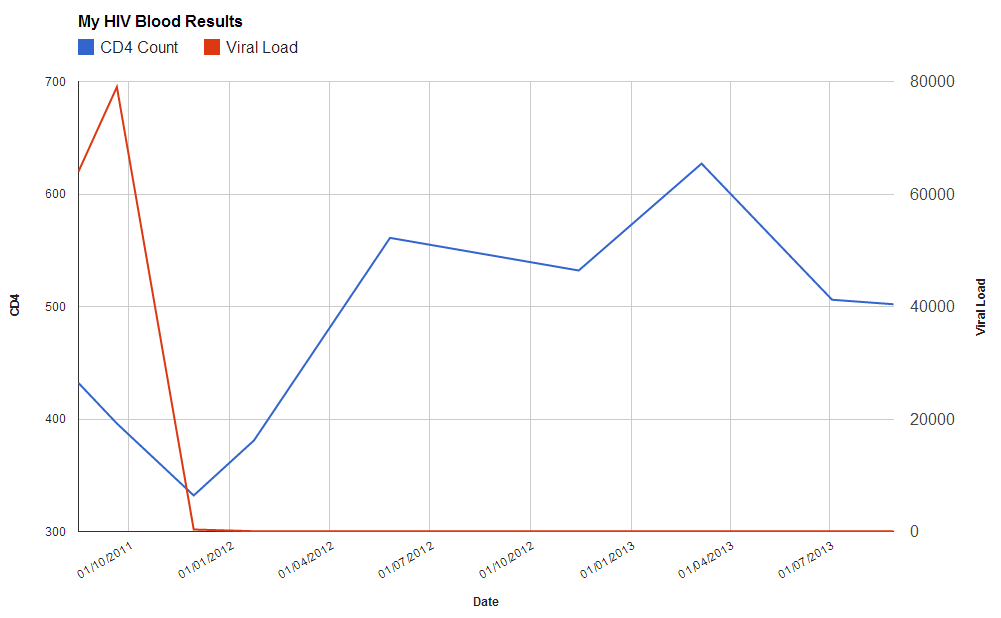
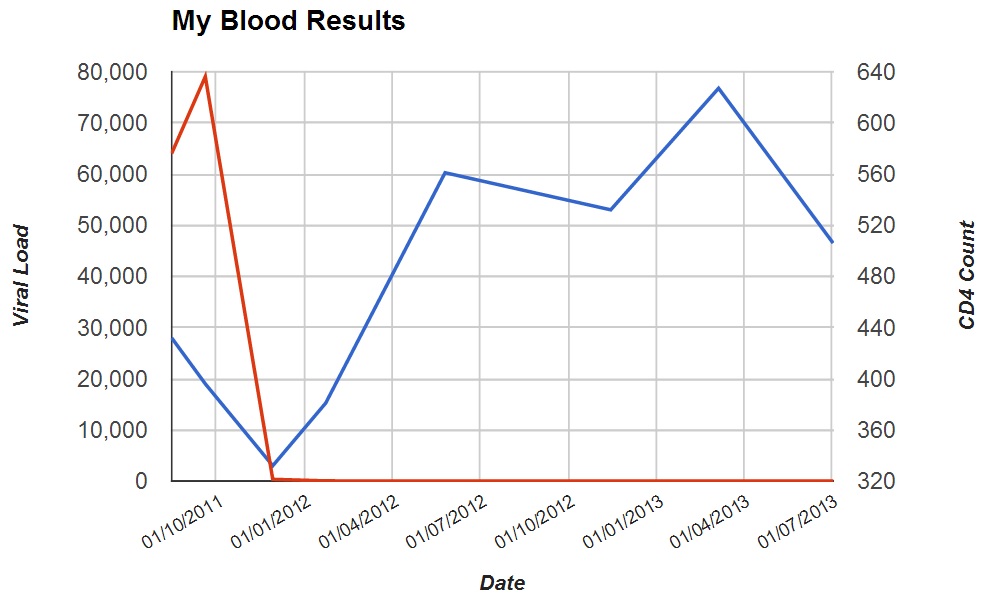
As you can see my CD4 has remained steady-ish, 502 at latest count and my Viral Load (VL) is staying at ‘undetectable’ with <39 copies per ml of blood. All of this is good news, it means my medication is working properly (always a worry when you change meds) and my immune system is holding up to the stress.
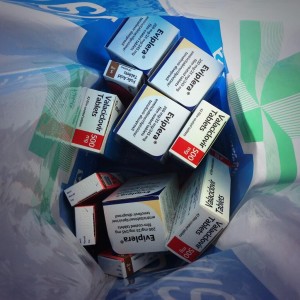 The only thing they did mention is that my blood cells are slightly larger than normal, at 100.7% of their normal size (which doesn’t seem much) so they’ve prescribed me some Folic Acid supplements to try and bring that back down to 100%.
After that I popped to the pharmacy to fill my prescription for four months of meds. Most people get a small paper bag when they collect their prescription, when they see me coming they get out a huge plastic bag… I’m actually surprised that I don’t rattle!
Have a great day,
Tom
UKPositiveLad
My HIV meds: life-saving breakthrough and complete ballache
It’s July 2013 and we’re rapidly approaching the second anniversary of my HIV diagnosis and I’ve been on treatment for almost as long now.
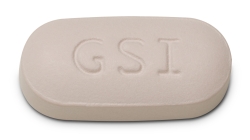 When I originally started treatment at the end of 2011 I was put on ATRIPLA, a one-a-day pill that combines three drugs – each one fighting HIV in a different way. That was fine until recently, then I started experiencing alarming side-effects including insomnia, hallucinations and mood-swings. My doctors changed me to a new drug, Eviplera, which once again is three drugs in a one-a-day pill.
My response to the treatment has been tremendous, I was ‘undetectable’ in only a couple of months and my CD4 has been on an upward climb ever since. So that’s the physical side of things taken care of. Great.
What the pills don’t do, however, is help with the psychological impact of living with HIV. In fact in some ways, for me at least, they make things worse. I hear people say things like “Oh HIV is just one pill a day now”, and on the surface that can be true – but things are so much more complicated than that.
The pills serve as a daily reminder that you’re HIV-positive, each night I look at that pretty substantial pill and think about what it means, the fact that this is forever. You also end up surrendering a little piece of your brain to keep track of your meds, they’re never far off your mind.
Have I remembered to take today’s pill? Have I eaten enough calories to go with it? Have I accidentally taken two today? Have I got enough on me to last until my next appointment? Oh crap I’ve gone out for the night without any! Where’s my open bottle of pills? Must remember to fill up my pill sorter! Must remember to fill up my keychain pill-box!
Tonight for example I’m off to the boyfriend’s house after work, then we’re both off out for drinks, I’ve packed an overnight bag so I can stay at his afterwards too. I thought I had spare pills on me, but I’ve checked and I don’t. This means I either have to go back to my house after work then onto his, then onto drinks – or hope that I’m compos mentis enough after drinks to go back home to mine collect the pills and then go back to the boyfriend’s house. Argh, it’s a proper ballache.
 Some of you might be thinking “Why not just skip tonight? Surely it won’t do you any harm.” – one night missed probably wouldn’t do me any harm that’s true, but then I’d start justifying other missed nights – skip too many doses and you run the risk of the HIV building a resistance to your medication and then you’ll have to change meds (and trust me, that’s not a pleasant experience).
The HIV medications we have in 2013 are a far cry from those of the nineties, they’re cleaner, simpler, have less side effects and dramatically increase the life expectancy of someone with HIV – without this one pill a day I have no doubt that I wouldn’t be alive now. But, people need to realise that it’s not like popping an Asprin when you can be bothered, it’s essential that these drugs are treated with respect – they need to be taken every day, at the same time, with the correct calorie intake otherwise they won’t work properly and your health will suffer.
HIV Meds – the life saving treatment that I’m so grateful for is also the thing that drives me round the twist. Life’s complicated sometimes isn’t it?
New Meds & Blood Results – July 2013
Why hello there,
As you may have seen on Twitter I was at the HIV clinic on Wednesday morning – collecting my results from my quarterly blood tests.
The tests monitor a number of things, my Viral Load (VL), CD4 count, CD4 percentage as well as kidney function, liver function, cholesterol, vitamin and mineral levels. The most important of these being my VL & CD4.
My VL has remained ‘undetectable’, and my CD4 has dipped a bit from 627 to 506 – but my consultant explained that whilst the count itself had dropped the percentage had actually gone up, this can be due to variation in sample sizes, the main thing to take away though is that my CD4 percentage is still rising, to 38% in fact, which is excellent. If you need further explanation of VL & CD4 head to this excellent interactive resource from aidsmap.com. I’ll make sure to get a record of my previous CD4 percentages next time I see the doctor to include in my graphs. Talking of which – HAVE A GRAPH…
I also started my new medication two weeks ago now. If you recall, I was experiencing horrible side effects on the ATRIPLA – which I talked about in my post ‘Am I mad, or is it the meds?’. My consultants changed me from ATRIPLA onto a newer medication, still in one pill format, called Eviplera. The pill is taking a little effort to integrate into my routine than I thought, previously I just popped my ATRIPLA when I climbed into bed at 11pm – but Eviplera is different, it has to be consumed with food (350kcal or higher). I’m finding myself having finished an evening meal and then suddenly thinking “Crap, I should have taken my pill with that meal!”, but I’m getting better at it.
The initial week was pretty hellish. As the ATRIPLA lingered in my system and the Eviplera started to take hold the two drugs (well six drugs, three per tablet) were clearly having some sort of battle royale in my organs. I felt dizzy, I was throwing up, I had headaches, I couldn’t eat – I could barely get out of bed. But now that I’ve adjusted I’m feeling so much better than I ever felt on ATRIPLA, I’m sleeping better, no more crazy dreams, no more hallucinations and I feel generally clearer in myself – almost like I’d been living in a fog before. Let’s hope that holds true in six months time.
Whilst I was at the clinic they mentioned that my red blood cells were larger than normal, but not by much. They’ve taken more blood to check for deficiencies in B12 and Folic Acid as a starting point. So I’m interested to see what comes back from those. It seems that in this case size really does matter.
Speak to you all soon,
Tom
UKPositiveLad
Life with HIV & Hepatitis C – Adam’s story
 There’s no doubt that HIV is an under-discussed issue and attracts a fair amount of stigma – but the situation regarding stigma and education about Hep C is even worse. Now imagine living with both.
I met ‘Adam’ via Twitter, he’s a gay guy in his thirties who has recently been diagnosed with both HIV and Hepatitis C. I asked him if he’d let me interview him for UKPositiveLad.com and he very kindly agreed, on the basis that it was done anonymously – which is entirely understandable.
THE INTERVIEW:
ME: Thanks for talking with me Adam, let’s start at the beginning. You’re HIV+, when did you find that out?
ADAM: I was diagnosed in January. I went to 56 Dean Street, they have something called the Code Clinic on Tuesday nights that is for gay men who have risky sex or use recreational drugs — it’s meant to be very non-judgmental, and really is. I was diagnosed with HIV, and with Hep C co-infection
ME: You got both diagnoses at the same time? That must have been difficult?
ADAM: I got the HIV diagnosis that same night, but I had to wait until the next week to get the results from the blood test. I was expecting the HIV to be confirmed, to find out about viral load, CD4, etc but I was not expecting to hear about Hep C. It felt like winning a really shit lottery… all my numbers came up… and then there’s the thunderball!
ME: So what happened next? Were there more tests or did you go straight onto treatment?
ADAM: My CD4 count was just over 200, which is really low. I started on ATRIPLA for the HIV just a month after my diagnosis. They also put me on antibiotics, which were really scary – I’m allergic to the one they usually give out, so they had to give me one that is normally used for people with leprosy. It was really strong and gave me upset stomachs, so that freaked me out even more.
ME: So that was January, we’re now in June – how are the two strands of treatment going? Let’s start with the HIV.
ADAM: Well, the HIV treatment is much better now. I was on ATRIPLA for the first two and a half months but I did not like it. I had very vivid dreams every night… mine tended to be like really heightened sitcoms, but sometimes they were thrillers. But the reason they took me off ATRIPLA, is because my liver function was very elevated.At one point, it was more than 1000% of what it should normally be, in a non-Hep C infected person. So now I’m on Truvada and Raltegravir - three tablets a day total, but not tied to sleep – it’s wonderful! I have an undetectable VL and my CD4 was 370 last week.
ME: What about the Hep C?
ADAM: Before I got to meet with the consultant, I had to do a series of tests…
The first step was going for an ultrasound. (Yes, just like pregnant ladies). It was me, and a corridor full of all these sweet hetero couples, they were all loved up, and waiting for their first scan. I felt totally awkward, as I didn’t bring a lady with me and obviously I wasn’t there cos I was with child. The ultrasound was normal, but I found out I have two gall stones (again with the random unexpected health news!).
After the ultrasound, they sent me on for another test, called a Fibroscan. It’s kind of like sonar, they hold the device up against your tummy and it ‘pings’ your liver. Based on how quickly the pings come back, they can get a reading of how fibrous your liver is. If your liver is damaged (ie, scarred), then it is more fibrous, and it takes the pings longer to come back. Unfortunately, the Fibroscan results were inconclusive. There are 4 levels of Fibroscan ratings: 1 is that your liver is fine, 4 is that it’s damaged – I was in the 2-3 ‘indeterminate’ range. However, they think this could just be because the ATRIPLA was causing such heightened liver function, that my liver was swollen.
 ME: So what’s the next step?
ADAM: So the consultant says that I have two basic choices. I can start treatment straightaway or wait 3 to 5 years, and see if any new treatment options become available.
I’m going to wait to start treatment in about 4-6 months. I have a few big projects I have just started that will finish by then — I do a lot of creative work, and have finally just adjusted to being HIV+ and into a good routine with those meds… so I kind of want to get through a few big things, before dealing with the side effects.
ME: What is the treatment as it stands? What are the side effects?
ADAM: Right, the treatment lasts for 48 weeks. For the 12 weeks there’s one pill once a day, there’s one pill you take every day for the entire 48 weeks, plus a weekly injection for the the each week for 48 weeks. All on top of my three pill a day HIV treatment.
The side effects of Hep C treatment are very strong, they can include anemia, a rash, depression and mood swings. However, they will normally treat the side effects, rather than withdrawing the Hep C treatment, if this is possible - which tells you how seriously they take the need to treat the Hep C.
ME: How’ve you felt about sex since both of your diagnoses in January?
ADAM: Sex is complicated. For the first few weeks, I was not interested in it at all, I was really worried that I had just gone off it entirely, but I’d got myself in such a mess, it wasn’t really even a concern.
I usually barebacked before, but now that is especially fraught. I used to think “oh, if I do end up HIV+, then it’s OK to bareback with other poz guys” - but that is really not the case when you have Hep C.
Given how many profiles on websites like BBRT now mention the “my last Hep C test” I’m sure I am not the only one who’s been dealing with it, and of course, whoever I got it from either didn’t know their status, or they did and carried on regardless.
ME: Have you told many people your Hep status? If so how has it gone down?
ADAM: To be honest, no I haven’t. It was really down to you and a few other openly HIV+ tweeters that I got up the courage to get tested, and face it all. I have told one or two good mates, who I used to have sex with and they have been supportive.
ME: There seems to be a lot of stigma attached to Hep C, especially among HIV+ gay guys. Have you felt that?
ADAM: I think part of it is down to ignorance of what is actually involved in treating Hep C, and in part down to a double standard where guys who are HIV+ and bareback (and, in many cases, use drugs recreationally as part of the fun) will then get all worried about getting Hep C, but not enough to curtail any of the activities that would put them at risk.
You see it all the time on hook-up websites – guys have pictures of themselves getting barebacked and fisted, they put they are positive and use drugs, but put in a note about their last Hep C test date which is often six months ago or longer. You have to wonder how much risky sex they’ve had since then.
ME: Finally, how much did you know about Hep C before you were diagnosed – compared to now? Was it on your radar?
ADAM: I knew Hep C was out there, but to be honest, I didn’t think I would get it. I had been into fisting for a while, but had been very careful about who I’d let up there. I didn’t really know much about the treatment, but I did know that it was generally treatable. I had known of at least 2-3 guys who were HIV+ who got Hep C, had the treatment and cleared it so I guess I wasn’t really worried about Hep C.
So yes, it was on the radar, but I wasn’t especially worried, and I knew that if I ever did get it, it would be treatable. But I had never considered the possibility of HIV and Hep C co-infection, or finding out at the same time. And I didn’t realise quite what all was involved in adjusting to treatment, and to the reality of the diagnosis.
-
Thank you to Adam for sharing his story with us, if you’d like to know more information about Hepatitis C you can visit the Hepatitis C Trust’s website http://www.hepctrust.org.uk/ and follow them on Twitter at @HepatitisCTrust
Love,
Tom
UKPositiveLad
Am I mad or is it the meds?
 It’s 00:50 and once again I can’t sleep.
My insomnia has kept me up for the best part of three days in a row now, my mind is tired, my body is exhausted and yet I still can’t sleep.
I go to the bathroom to top up my water glass and I catch a glimpse of myself in the mirror, I look like death warmed up – my skin pale, bags under my eyes so big you could carry your shopping in them, and I’m breaking out in spots -my body has had enough but my HIV meds won’t let me sleep.
This has been going on for months upon months now, sleeping only three or four nights a week, the rest sat up trying to keep myself busy until it’s time to goto work. Sadly it’s become something of a routine – a routine that’s causing me to burn out.
I wish I could say that insomnia was the biggest of my concerns, but sadly it gets worse, over the last few weeks things have been going bump in the night. I’m hearing and seeing things that aren’t there. It started off as little things, a thud in the hallway, a shadow out the corner of my eye – but progressively they’re getting more and more significant – I’ve heard the front door being hammered only for no-one to be there, giant spiders on the ceiling, I’ve even seen myself sat in my desk chair.
I’m reasonably sure that it’s not a inherent problem with my mind, so much as the medication – the hallucinations only happen after I’ve taken my meds and on nights I can’t sleep. So I think it’s pretty reasonable to conclude that they’re side effects that I’d normally sleep through – but in my perma-awake state I have to endure. What I’m not sure, however, is why they’ve only started now – nearly 18 months after I started this combination therapy.
I’ve asked my doctors to change my HIV meds before based on my sleeping issues but they’ve told me to wait it out, I’m hoping when I see them on the 17th that they’ll take the news of hallucinations and even less sleep slightly more seriously. Either that or they’ll lock me up, and if they do I hope they have wine.
Tom
UKPositiveLad
Welcome to Club Insomnia

It’s 04:44am. I’m laying in bed. Wide awake.
I can hear the distant whoosh of cars on the main road, the hum of fridge freezer, that irritating high pitched noise that you’re not sure if it’s your ears or something buzzing or something else making it, and most disturbingly of all – my own thoughts.
I’ve been trying to get to sleep since midnight. I did all the right things – I had a relaxing bath, drank some water, took my pills, turned my phone off, turned my computer off, turned the lights off and got comfy. Sadly the sandman didn’t want to pay me a visit.
Laid there in total darkness I tried to clear my mind of all thoughts. But as soon as I’d done that they flooded back again. What am I going to do about money? What’s going on with that guy I like? Did I have plans for tomorrow? What do I need to do for work tomorrow? Oh god work tomorrow. Did I put my headphones on charge? Did I take my meds? Whilst all the time thinking “WILL YOU JUST SHUT UP – I NEED TO SLEEP”.
At 3am I realised sleep clearly wasn’t happening and at 4am I completely gave up all hope of achieving any sleep.
The medication I take to control my HIV, ATRIPLA, is made up of three drugs Emtricitabine, Tenofovir and Efavirenz. Apparently Efavirenz is widely know to cause insomnia – I’ve never been the best sleeper, but I can’t imagine that this is really helping matters. Some people have suggested that I move to another drug combination that doesn’t include Efavirenz but these aren’t available in single pill from the NHS and I don’t know how well I’d cope with multiple pill treatment – plus I don’t really want to burn my bridge with ATRIPLA if I don’t have to.
It’s now 5am. I have to get up for work at 7:30. Do I try and sleep for that 150 minutes, or do I just get up and go into work early? Whatever I do, however, I can confidently say that my Thursday will be a complete write-off. I’ll be heavily reliant on bad instant coffee to keep me awake at work, but it won’t be proper awake, it will be Zombie Tom – lights are on, but nobody is at home.
I really envy people who, like my pets, can just put their head down and go to sleep straight away. That’s never something that’s worked for me, I’ve always found it hard to get to sleep and it’s just getting harder as the years and pills continue.
Here’s a quote from D.D. Barant that seems appropriate:
“I’ve got a bad case of the 3:00 am guilts – you know, when you lie in bed awake and replay all those things you didn’t do right? Because, as we all know, nothing solves insomnia like a nice warm glass of regret, depression and self-loathing.”
I hope you have a better Thursday than I’m going to.
Best wishes,
Tom
UKPositiveLad
Latest Blood Results – March 2013
G’day Lads and Lasses,
Yesterday I went to my local HIV Clinic at the lovely Queen Elizabeth Hospital Birmingham. I popped in to get the results from my routine blood-work I had done last week.
My consultant gave me my latest figures: My CD4 is up from 534 to 627 (yay) and my Viral Load remains undetectable (double yay).

Now for those of you who aren’t au fait with the terminology here are some a couple of quick explanations from aidsmap.com:
- T-cells (or T-lymphocytes) are white blood cells that play important roles in the immune system. There are two main types of T-cells. One type has molecules called CD4 on its surface; these ‘helper’ cells organise the immune system’s response to bacteria, fungi and viruses. The other T-cells, which have a molecule called CD8, destroy cells that are infected and produce antiviral substances.HIV is able to attach itself to the CD4 molecule, allowing the virus to enter and infect these cells. Even while a person with HIV feels well and has no symptoms, billions of CD4 cells are infected by HIV and are destroyed each day, and billions more CD4 cells are produced to replace them. Doctors use a test that ‘counts’ the number of CD4 cells in a cubic millimetre of blood. A normal CD4 count in a healthy, HIV-negative adult can vary but is usually between 600 and 1200 CD4 cells/mm3 (though it may be lower in some people).
- Viral load is the term used to describe the amount of HIV in your blood. The more HIV there is in your blood (and therefore the higher your viral load), then the faster your CD4 cell count will fall, and the greater your risk of becoming ill because of HIV. Viral load tests measure the amount of HIV’s genetic material in a blood sample. The results of a viral load test are described as the number of copies of HIV RNA in a millilitre of blood. But your doctor will normally just talk about your viral load as a number. For example, a viral load of 10,000 would be considered low; 100,000 would be considered high.
- All viral load tests have a cut-off point below which they cannot reliably detect HIV. This is called the limit of detection. Tests used most commonly in the UK have a lower limit of detection of either 40 or 50 copies/ml, but there are some very sensitive tests that can measure below 20 copies/ml. If your viral load is below 50, it is usually said to be undetectable. The aim of HIV treatment is to reach an undetectable viral load.But just because the level of HIV is too low to be measured doesn’t mean that HIV has disappeared completely from your body. It might still be present in the blood, but in amounts too low to be measured. Viral load tests only measure levels of HIV in the blood, which may be different to the viral load in other parts of your body, for example in your genital fluids, gut or lymph nodes.
The dietician is slightly concerned about my weight however, I used to weigh between 62 and 64kg (that’s 9st 10lb – 10st in old money) and now I weigh 56Kg (8st 11lb). So they’ve put me on a new diet – where essentially they want me to be eating all day long. Lots of things rich in sugar, fat, dairy and protein. Not sure how I’m going to afford that mind!
To combat the rising number of cold-sores I’ve been getting too my consultant has put me on a daily dose of Valaciclovir to combat those at the root cause, hopefully we can get that under control too. All in all a pretty productive trip to the hospital, all done for four months now!
Until tomorrow lovely people,
Tom
UKPositiveLad
Your HIV questions answered by DrEd.
Currently 100,000 people are estimated to be living with HIV in the UK, but an estimated 25% of those are undiagnosed.
That’s 25,000 people who have HIV and don’t know about it! As we come to the end of HIV Testing Week in the UK and approach World AIDS Day 2012 I put some of your questions about getting tested and HIV to Dr Sebastian Winckler from DrEd.
1. Why is it so important to get tested for HIV?
Early testing is vital both for you, and for the people you’re sleeping with.
If you’ve got HIV and you’re getting treatment you can expect to live 40 years longer than someone who isn’t receiving treatment.
If you’re taking antiretroviral medication, you become less infectious to other people. Being aware of your status means you can start putting certain measure in place (such as safe sex)
to prevent transmission, as well as looking after your own health.
2. What stops some people from getting tested?
There are a lots of reasons why people avoid HIV tests, but usually it’s down to:
- The stigma surrounding HIV and AIDs: Despite advancements in treatment, in some communities there is still stigma about being HIV+, so many people feel embarrassed about getting tested. Remember, there is no shame in being HIV+.
- The inconvenience of testing: If you work during the day, it can be hard work finding the time to go.
- Fear: Some people are simply scared off getting a result they don’t want to hear. Remember though, it’s better to get tested and treated rather than making yourself, or others, ill.
3. Where can I get tested?
HIV tests are available free and confidentially from:
- Sexual health (GUM) clinics
- HIV testing centres (Terrence Higgins Trust Fastest centres, for example)
- LGBT Centres
- GP’s and family doctors
- HIV tests are available to buy from:
- Private clinics
- Online doctors services
4. I haven’t had any symptoms, so I probably don’t have HIV, right?
Wrong. Most people will experience a short, flu-like illness about 2- 6 weeks after being infected. This is your immune system putting up an initial fight against the virus and can last for up to a month. But, this can be easily mistaken for the flu and 20% of people don’t experience any symptoms at all.
After this has gone away, you are unlikely to notice any other symptoms for a long period of time. So the only way of knowing for sure is getting yourself tested.
5. Can a test pick up any HIV infection, regardless of when I’ve caught it?
No. A certain amount of genetic material needs to build up in your system before it can be accurately detected by a test. The time taken for this to happen is called the ‘window period’ and this is different for every test.
- The standard antibody (Ab) test will pick up HIV if you caught it more than 3 months ago.
- The combined antibody/ antigen test (4th Generation test) will pick up HIV if you caught it more than 6 weeks ago.
- The HIV PCR test will pick up HIV if you caught it more than 7-10 days ago.
In most cases, you will be given either the standard antibody or combined test. If you test negative for these, it doesn’t necessarily mean that you are HIV negative, because you might have been infected within the last 3 months (or 6 weeks). You are therefore advised to take a second test 3 months later for the all clear.
If you want a faster result you can pay for a PCR test. But these are only offered at some clinics and may cost up to £250.
6. I think I’ve caught HIV within the last few days, what do I do?
If you’re worried that you’ve contracted HIV very recently, as in, within the past 72 hours (3 days) then you should go to your local GUM clinic or A&E department and request emergency PEP treatment.
7. I’m afraid to get tested because I don’t like needles
HIV tests don’t have to be done via needle or syringe, some clinics use ‘Fastest’ Rapid Testing which simply takes a prick on the end of your finger. Other clinics may take oral swabs instead, this method is considered less effective than a blood test however, so some clinics won’t offer it.
8. How long do I have to wait for my results?
That depends on the clinic you go to. Most will contact you with your result (or ask you to come back in for it) within 3-5 days. If you take a rapid test your result will be ready within the hour. Some clinics can take up to 2 weeks however, don’t be afraid to ask when you should expect the results.
9. What happens if I test positive?
First off, a positive result doesn’t always mean you’re HIV+. There is a small margin of error, so all positive results must be followed up by a confirmation test.
If you do test positive for that, then the doctor or nurse who informs you of your result will set up a meeting with a specialist who can assess the stage of your infection and talk to you about relevant treatment options. You’ll be put in touch with local HIV support groups who can help you cope emotionally, and make you realise that a positive result is not the end.
Thirty years on and HIV is still a problem in the UK, but it is no longer a death sentence. There is help out there and the earlier you get tested, the better your prospects. Whatever you do, make sure you get tested this HIV Testing Week.
Some charities that can help:

My Latest Results
Happy Moist Wednesday to you all,
Yesterday I went to collect the results from my triannual (is that a word? three times a year anyway) HIV check up at the clinic. I’d been in the week before and had the full battery of tests – 8 vials of blood and a urine sample, along with a full standard STI (sexually transmitted infection) screening. It takes one week from the tests to get all the results, so in I popped after work.
It always surprises me how lovely the staff are, they always remember my name despite the hundreds, if not thousands, of people they see between my check-ups. My usual consultant wasn’t available, sunning himself in the tropics – alright for some, so I saw a different lady who had me laughing the entire time.
The long and short of it however is my Viral Load is holding at <39 (which means undetectable), and my CD4 was a respectable 532 (see chart below), my CD4 is a bit down from last time, but the doctor attributed that to my recent bout of flu. So that’s all good. The STI screening was clean as a whistle too – hardly surprising given my pretty quiet bedroom life of late.
I saw the dietician who told me that my cholesterol, kidney and liver functions were all fine – and quizzed me on how healthy my diet was. The physiotherapist moaned at me for not doing enough exercise, and the health advisor gave me a suitcase of condoms and lube.
On to the pharmacist we had a yearly medication review, we discussed my minor side-effects (occasional insomnia and crazy dreams) and decided that it was best to stick with the current medication regimen. I was offered a new home delivery service for my medication as it was suggested it would be more convenient for me, but then I’d have to wait in for the delivery (or else trek to the Post Office) and I have to come in every four months for my check-up anyway, so might as well collect them then.
I picked up my four month supply of ATRIPLA and headed home. At £626 per month (cost to the NHS) that meant I was carrying £2,504 of medication around. I felt like it should probably be handcuffed to me like in the movies! Thank goodness that it doesn’t cost me a penny on the NHS, not even a prescription charge. A lot of people complain about the NHS, and sure it does make mistakes but then what organisation doesn’t. We’re very lucky to have such an institution in our country – make the most of it whilst you can before the Tories dismantle it.
I hope you’re all well!
Sam
UKPositiveLad
