Blog Archives
Talking HIV, testing & stigma on ITV Daybreak & BBC Radio 5 Live
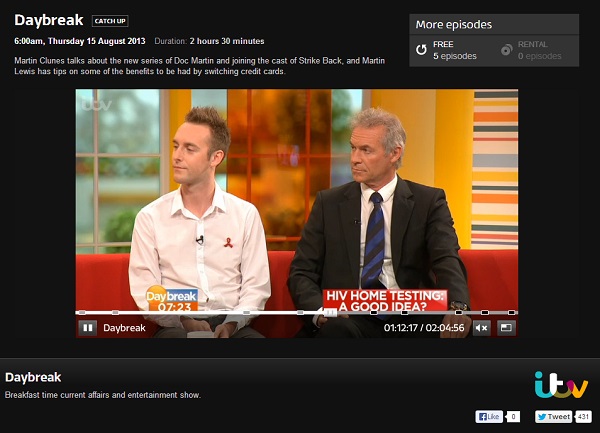
Well the last twenty-four hours have been interesting. Yesterday afternoon I got an email from a producer at ITV’s Daybreak breakfast show asking me to give them a call, it turned out they wanted me on the sofa the next morning to give my opinion on the HIV home testing kits that are due to be legalised come April 2014.
I ended up being booked onto a train only a couple of hours later, a car met me at Euston and took me to my hotel where a camera crew turned up to shoot promos, they left about midnight and I set my alarm for 05:00am. My alarm went off, I got up made myself presentable and a car took me to the studio. After several coffee’s I got plonked on the Daybreak sofa with Dr Hilary Jones and we were interviewed by Matt Barbet and Kate Garraway. I think it went pretty well – but you can check out the interview here: https://www.itv.com/itvplayer/daybreak/15-08-2013 (I’m on at 07:23am).
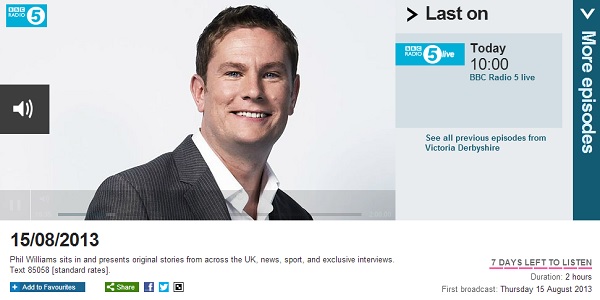
The car picked me up again and dropped me off at London Euston. Just as I was about to board my train I got a call from SavingLivesUK who wanted me to talk on their behalf on BBC Radio 5 Live’s morning show. So they sent another car for me, whisked me off to BBC Broadcasting House and I was interviewed alongside Sir Nick Partridge of the Terrence Higgins Trust by Phil Williams. It was a much more in-depth piece on HIV, focusing on stigma and the lifting of the ban on HIV+ healthcare professionals. You can catch the interview on BBC iPlayer here: http://www.bbc.co.uk/programmes/b0388b33
After that I headed back to Euston and got a train home to Birmingham. Now I’m sat in my office at my day job struggling to keep my eyes open. I’m going to sleep well tonight!
Let me know what you think of the interviews in the comments section below!
Love,
Tom
UKPositiveLad
VIDEO: Speaking on Sky News about my diagnosis and HIV home testing kits.
On Sunday morning I awoke to a new follower, a producer on the Sky News team. Shortly after that I received a tweet and a DM from my new follower asking if I could talk on the phone, that was at 11am, by 3pm I was in front of the camera and waiting to go on air to talk about HIV home testing kits and my own experience of being diagnosed HIV-Positive.
You can check out my interview on the YouTube video below – and don’t forget to subscribe to my YouTube Channel to get updates of whenever I upload a new video!
Many thanks to Sky News for having me on to share my story, and permitting me to share the video clip with you.
Tom
UKPositiveLad
Just Get Tested Already

Morning all,
On a daily basis I get maybe thirty or forty emails from people reading this column or people visiting my website. Some are asking for support, others asking questions about HIV, a few are even hate-mail (the crazies are everywhere) – and an alarming number telling me that they’ve never had a HIV and/or STI (Sexually Transmitted Infection) screening.
Of course I always handle these messages sensitively. I suggest that they should go and book themselves in for a full STI screening and even provide a link to the Terrence Higgins Trust website where they can pop in their
postcode and find a clinic near them. But the whole exchange often leaves me baffled and concerned. Many of these people are in their mid-to-late twenties – how they have got this far in life (presumably having sex along the way) and never having had a check up?
Is it simply a case of sticking their heads in the sand or is there something more going on here? Having spoken to some of them in more depth there’s definitely some ostrich like behaviour for sure, for some ignorance really is bliss, if you don’t know something is wrong then you don’t need to worry about it – but for others it’s a fear of the testing process itself, and this can only be due to lack of education around the topic.
Going for a STI screening really is not that big a deal. Honestly. I went for one only the other month (I go every six months – and so should you if you’re sexually active). Here’s what happened:
I arrived at the clinic at about 10am. I sat around watching Jeremy Kyle in the waiting room until I was called through by a doctor. They ask you a few simple questions:
Why’ve you come in today? “routine testing”,
Do you have any symptoms? “none”,
Any pre-existing conditions? “HIV-positive”.
After that I head back to the waiting room for a couple of minutes for a spot more Jezza (turns out he wasn’t the father). Then a nurse calls me through to one of the other rooms. She takes a couple of throat swabs (say “ahhhh”), a tiny swab from the end of my penis (it does pinch a little, but it doesn’t hurt), and a swab from my ass. Another nurse comes into to take a couple of vials of blood and then I’m given a little bottle to go put a urine sample in. I’m good to go. That’s it! takes about 45 minutes, one hour tops. They’ll text me any results in two weeks time.
(If I didn’t already know that I was HIV-Positive they would have also offered a HIV Rapid Test, which gives you a result in 15 minutes)
It’s incredibly important that each of us get regular STI screenings. Most sexual health charities recommend twice a year or more frequent if you’re more sexually active. Whilst you may not have any symptoms you may still carry any number of infections without even knowing it. I myself had absolutely none of the ‘flu-like’ symptoms often associated with HIV and only found out at one of my regular screenings.
Getting checked out doesn’t just mean that you’re looking after yourself, it means you’re showing respect and looking out for those who you sleep with – after all you’d hope anyone you slept with to have been checked recently, wouldn’t you?
So if you’ve never been checked out, or maybe it’s been far too long since your last test perhaps today’s good deed could be calling up your clinic and booking yourself in for a little MOT. Don’t know where your nearest one is – sorry, that’s no excuse. Head over to THT.org.uk and click ‘Sexual health’ to use their ‘Service Finder’ tool.
Take care,
Tom
UKPositiveLad
Early Diagnosis: Benefits and Challenges
When it comes to HIV there are a lot of medical terms bandied about, things like viral load, CD4, HART, ARV, advanced infection and resistance to name just a few, and if you (like me), are not a doctor these can initially be somewhat confusing. What I’m talking about today however is ‘Early Diagnosis’.
Early Diagnosis is just that, making a diagnosis of HIV in the early stages of the disease. Whilst there is no defined time scale for Early Diagnosis it’s widely taken to mean within a year of the initial infection.
What are the benefits to Early Detection?
- You can start receiving specialist care. Some people may not need treatment for years, others like myself, might start in a matter of months. But once you’re under the care of a HIV clinic their regular monitoring will make sure you stay in tip top condition and recommend treatment to you - when it’s appropriate.
- You’ll live longer. Studies have shown that the earlier you’re diagnosed the longer you’ll live. Things have come on in leaps and bounds in the last 30 years and someone diagnosed in their twenties will now live until their mid-seventies, and that’s without any advances in care that happen in the meantime.
- You can protect others. Knowledge is power. By knowing that you’re HIV+ you can inform past sexual partners that may have been at risk, and make more informed and responsible decisions with any future partners. Modern treatment can also reduce the risk of passing on the infection by upto 96%.
What are the challenges to Early Detection initiatives?
- Ignorance. Many people believe that they’ll know if/when they have HIV through symptoms such as a flu, or a rash. However, many people who contract HIV, myself included, show no symptoms at all, and even if they do experience flu like symptoms they may think it’s just the flu and nothing more serious.
- Fear. The idea that you may have HIV isn’t a nice one, in fact for most people it’s down right terrifying. This leads to people burying their heads in the sand and putting off testing. Other people are put off because they’re afraid of the tests themselves, when in fact most HIV testing is done in minutes with a simple prick test.
- Denial. I didn’t think I’d ever get HIV. I’m in my twenties, I was look after myself, HIV doesn’t happen to people like me does it? Wrong. HIV can happen to anyone, and at any time.
So, what next?
- Inform the masses. HIV awareness campaigns tend to be limited to niche publications, such as the gay press. I think there’s a pressing need for a national campaign, both in print and on TV, but unlike the adverts of the 80′s we need to inform, teach and encourage to test rather than shock and scare.
- Fight the stigma. There is still a lot of stigma surrounding people living with HIV, again this is firmly rooted in the 80′s where HIV and AIDS was portrayed as a dirty disease that affected dirty deviant people. We need to show that HIV affects people from all walks of life, and can be contracted in any manner of ways.
- Encourage testing. Through these new campagins, both nationally and targetted at specific communities, we need to encourage regular testing. Let people know that it takes only a few minutes, doesn’t involve needles and is free of charge.
Please, if you can, donate to one of the HIV charities and help them raise awareness and provide services. Consider reblogging/retweeting/facebooking/sharing this blog post to your followers and friends to do your part to raise awareness about the benefits of Early Detection. It only takes one click and could positively impact on any number of lives.
Love and respect,
Sam
UKPositiveLad